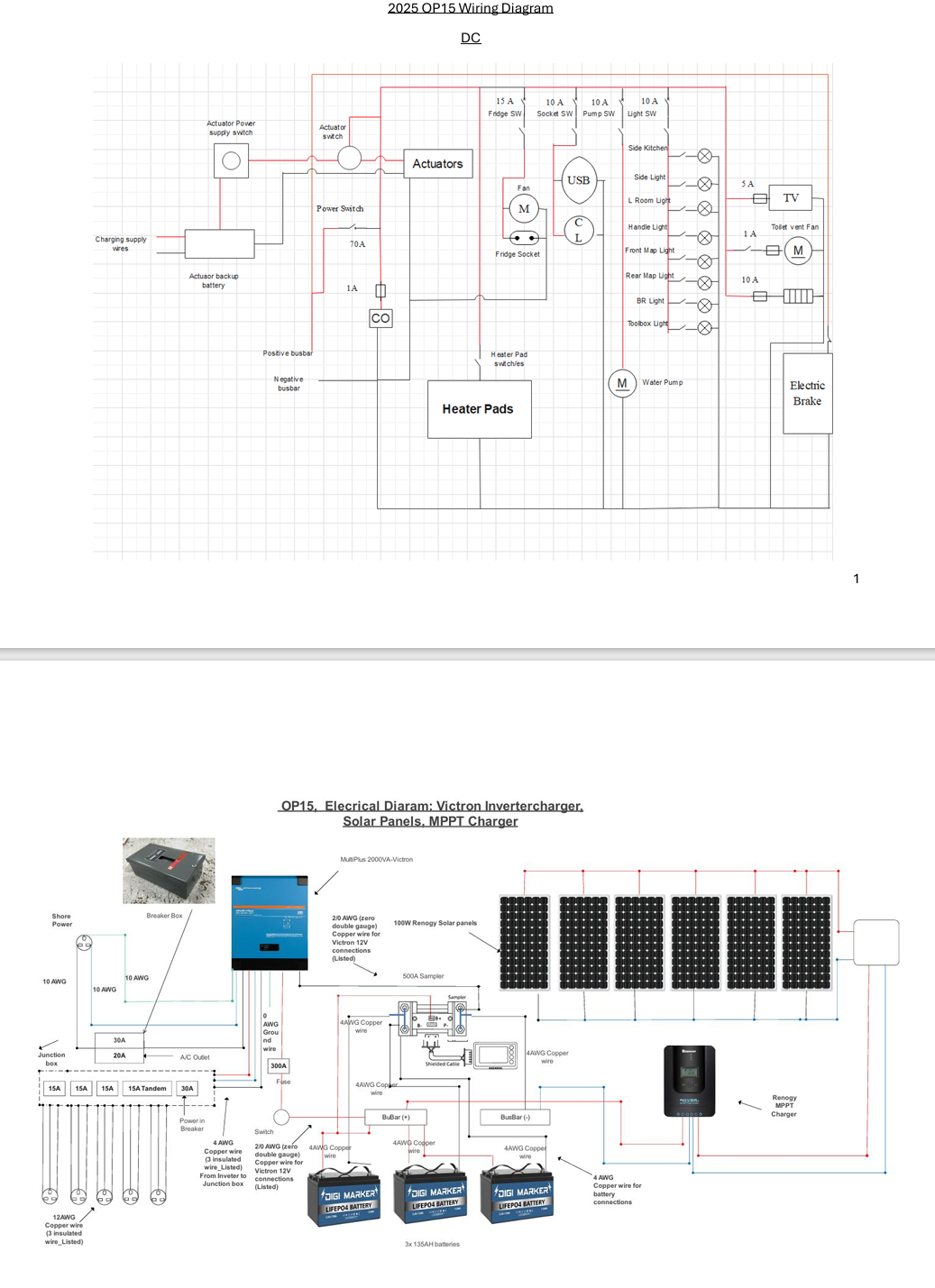
Overview The 2025 Opus OP15 electrical system uses Purple Line design compliant with NFPA 1192, FMVSS 571, SAE J560, SAE J1889, and FMVSS 108. Wiring employs marine-grade copper conductors insulated with T90 nylon 75 °C. Diagrams cover:
- DC power distribution (positive/negative busbars, fused circuits)
- Victron MultiPlus 2000VA inverter/charger integration
- 100 W Renogy solar panels with Victron MPPT controller
- 7-pin vehicle hookup, chassis breakaway, and external lighting
- Interior 12V/110V combined circuits (actuators, heater pads, appliances, lighting, pumps)
High-resolution versions are in the 2025 OP15 Owner’s Manual on the Opus Owner Portal. Modifications require a certified RV technician to preserve warranty and safety compliance.
Key Diagram Summaries
DC Distribution & Busbar Layout
- Positive busbar feeds fused circuits:
- 15 A: Fridge switch/socket
- 10 A: Socket switch, pump switch, light switch
- 5 A: TV/stereo
- 1 A: Toilet vent fan
- 10 A: Rear map light, BR light
- Negative busbar grounds all loads.
- Actuator backup battery isolated via actuator power supply switch and 70 A main fuse.
- Heater pads controlled by dedicated switches.
- Water pump, USB, side kitchen lights, L-room light, handle light, front map light, toolbox light, bed fans routed through respective 10–15 A fuses.
- Electric brakes wired separately.
Victron Inverter/Charger & Solar Integration
- Victron MultiPlus 2000VA inverter/charger connected via 4 AWG copper (positive/negative) to busbars.
- 3 × 135 Ah LiFePO4 batteries (BigBattery or equivalent) paralleled with 4 AWG copper.
- 4 × 100 W Renogy solar panels wired to Victron MPPT controller (20 AWG double-gauge copper for panel connections).
- Shore power inlet → 30 A breaker → transfer switch → MultiPlus → battery charger output.
- 40 A MPPT controller output to busbars.
- 500 A shunt for battery monitoring.
- Fuses: 300 A main near batteries, 30 A AC side, 15 A tandem breakers for outlets.
7-Pin Hookup & Chassis/Trailer Lighting
- 7-pin flat connector:
- Brown (BR 10 GA): Right turn + brake lights
- Red (R 10 GA): Left turn + brake lights
- Green (GR 14 GA): Tail/marker lights
- Yellow (Y 14 GA): Auxiliary 12V power/charging
- White (W 10 GA): Ground
- Black (BLK 14 GA): Brakes (breakaway circuit)
- Blue (BL 14 GA): Electric brakes
- External lights: Front markers (amber), side markers (amber), rear tail/turn/brake (red), license plate light.
- Breakaway switch interrupts brake power on disconnect.
- Wires routed through frame to junction box; compliant with SAE and FMVSS standards.
Interior 12V & 110V Combined Wiring
- Marine master switch isolates battery input.
- 12V circuits: LED lighting (side kitchen, handle, L-room, front/rear map, toolbox), water pumps (WP1/WP2), fridge socket, USB outlets, stereo, TV fan, toilet vent fan, compressor, dimmer switches, momentary switches.
- 110V circuits: Shore power → transfer switch → MultiPlus → GFCI outlets (multiple 110V locations).
- Inverter feeds select outlets when off-grid.
- Fuse/breaker ratings: 15 A fridge, 10 A pumps/lights, 5 A stereo/TV, 1 A vent fan.
- Wire colors: Black (110V live), white (neutral/ground), red (12V +), blue (pumps), yellow (fridge/fan), green (ground), brown (outlet sockets).
Troubleshooting Tips
- No 12V: Check marine switch ON, 300 A main fuse, 70 A actuator fuse, busbar connections.
- No shore/inverter power: Verify transfer switch, 30 A breaker, MultiPlus LED status, GFCI resets.
- Specific circuit failure: Inspect labeled fuse (e.g., pump only → 10 A pump fuse).
- Low battery charging: Confirm MPPT controller display, solar panel voltage (>18 V open-circuit), shunt reading.
Safety Notes
- Disconnect shore power and battery negative before inspection.
- Annual certified RV technician inspection required for warranty.
- All non-current-carrying metal must remain grounded.